
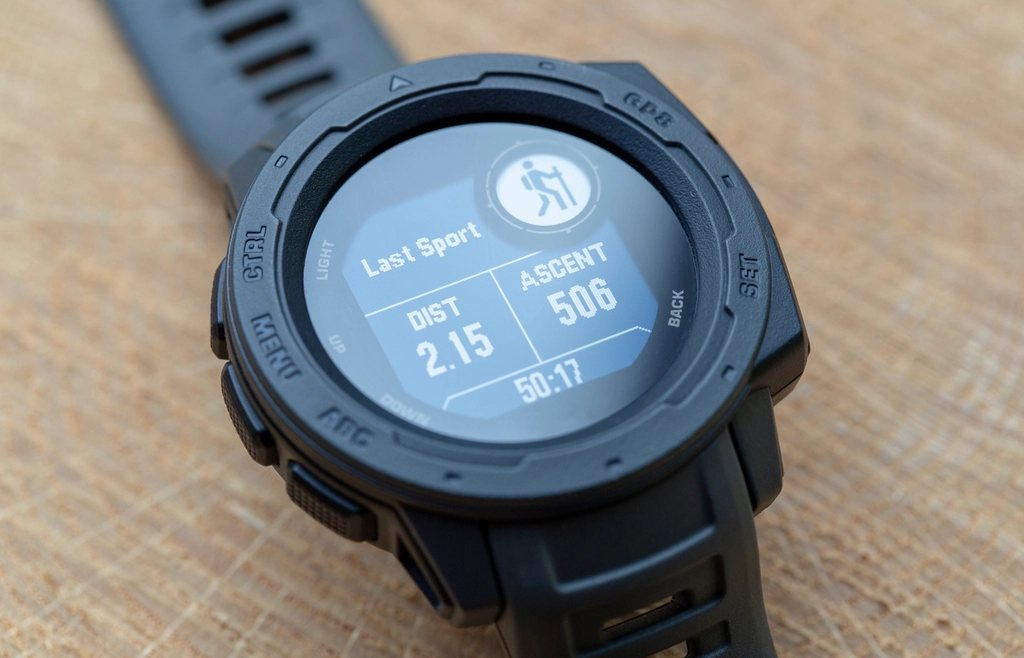
Every fitness watch now measures heart rate from the wrist, and the marketing implies the chest strap is a relic. The published evidence is more nuanced. Under the right conditions a good wrist sensor tracks a chest strap within a couple of beats per minute. Under the wrong conditions it can be 20 or 30 bpm off for minutes at a time without any warning on the screen. This article explains how each technology works, where the optical approach breaks down, what independent validation studies have measured, and which sensor to trust for which kind of training.
Two different physical signals
A chest strap is a wearable electrocardiogram in miniature. Two conductive pads on the strap pick up the small electrical voltage, around 1 millivolt, that the heart muscle generates with every contraction. The sharp spike of each beat, the R wave, is easy to detect electronically, so the strap counts beats directly and reports the interval between them to within a few milliseconds. The signal is electrical, not mechanical, so it does not care whether you are sprinting, cycling over cobbles or lifting a barbell. Its weaknesses are practical: the pads need moisture to conduct, the strap has to sit snugly under the chest muscles, and the elastic and battery wear out.
A wrist sensor uses photoplethysmography, usually shortened to PPG. A green LED, typically emitting around 525 nanometres, shines into the skin and a photodiode measures how much light comes back. Blood absorbs green light strongly, so each pulse of arterial blood produces a small dip in reflected light. The watch samples that dip many times per second, filters the waveform, and estimates the pulse rate. It is measuring blood flow in skin capillaries, not the heart itself, and the pulse arrives at the wrist tens of milliseconds after the heartbeat. Everything that changes skin blood flow, the optical path or the position of the watch changes the signal.
Where wrist sensors fail, and why
Cold is the most common problem. Below roughly 10 degrees Celsius the body constricts blood vessels near the skin to conserve heat, so the pulsatile signal at the wrist shrinks. The sensor compensates by increasing LED brightness and relying more on its motion model, which is when readings start to drift. Runners in winter often see a heart rate that is 20 to 40 bpm too low for the first 10 or 15 minutes, until the skin warms.
Tattoos absorb and scatter light. Dark ink under the sensor can block enough green light that the watch reports nothing or a wildly wrong value. Several manufacturers acknowledge this in their documentation. Skin pigmentation has a smaller but measurable effect in some studies, because melanin also absorbs green light; recent sensors add red and infrared LEDs partly to reduce this bias. Wrist position matters too: a watch worn on the wrist bone or strapped loosely lets ambient light in and lets the sensor slide across the skin with every stride.
Cycling produces a specific failure. Road vibration and the tension in the forearms create a mechanical signal at the wrist that the algorithm can confuse with the pulse, and the hands on the bars restrict blood flow. Studies on indoor and outdoor cycling consistently show wider error than for running. Strength training is worse still: gripping a bar compresses the wrist, and the heart rate rises and falls in seconds, which the smoothing cannot follow. Finally, high-cadence running invites cadence lock, where the reported heart rate equals your step rate for minutes at a time.
What the validation studies actually measured
Independent studies compare each device against a reference ECG across walking, running, cycling and sometimes strength work, and report the mean absolute error and a concordance statistic. The pattern across a decade of this literature is consistent. Chest straps typically show a mean absolute error of 1 to 3 bpm against ECG with a concordance above 0.98, essentially interchangeable with the reference for training purposes. Wrist optical sensors show a mean absolute error of roughly 3 to 8 bpm during steady running or walking, but 8 to 15 bpm or more during cycling, intervals and resistance exercise, with individual outliers exceeding 30 bpm.
Two other findings matter for interpretation. First, wrist errors are not symmetrical: during hard effort the sensor tends to under-read, and during rapid changes it lags by 5 to 15 seconds. Second, the average error hides the distribution. A study may report a mean error of 5 bpm while 10 percent of the readings are more than 15 bpm wrong, which is what ruins a heart rate-controlled interval session. Optical upper-arm bands, which sit on a well-perfused muscle away from tendons and the wrist bone, typically land between the two, with mean errors of 2 to 4 bpm across most activities.
Which to trust for which task
Match the sensor to the question you are asking of the data.
- Easy steady runs and walks: wrist optical is adequate, and averages over 10 minutes or more will be within a few bpm of the truth.
- Threshold tests, heart rate-guided intervals, anything where a 5 bpm error changes your training decision: chest strap.
- Cycling, especially outdoors or on rough roads: chest strap or arm band; wrist readings are the least reliable here.
- Strength training and circuits: chest strap if you care about the numbers at all; wrist data is mostly noise.
- Resting heart rate and overnight trends: wrist optical is actually good, because you are still and warm, and the beat-to-beat variability metrics derived overnight are usable.
A useful rule is that the wrist sensor is a fine thermometer for your whole week and a poor stopwatch for a single interval. Use it to watch resting heart rate drift up during illness or overtraining, and to accumulate time in zone across easy sessions. Use the strap when the session itself depends on the number.
How to check your own watch in an afternoon
You do not need a lab to find out how your wrist sensor behaves on your arm. Wear a chest strap paired to a second device, or to a phone app, and run your normal watch on the wrist at the same time. Do a 40-minute session that includes 10 minutes easy, 6 intervals of 1 minute hard with 1 minute easy, and 10 minutes steady. Export both recordings and line them up. Look for three things: the lag at the start of each interval, the size of the gap during the hard minute, and whether the wrist trace ever flattens at a number close to your cadence. Repeat once in cold weather and once on a bike. Most people find their wrist sensor is fine for the easy and steady portions and unusable for the 1-minute repeats, which is exactly what the published studies predict.