
A running watch that says 10.00 km when you ran 9.85 km is off by 1.5 percent, which sounds trivial until you notice it moved your 5 km pace by 5 seconds per kilometre and your “record” was set on a course that was 150 metres short. GPS error is not random noise around the truth; it has structure, it depends on the sky above you, and it differs between the two receiver designs now sold in running watches. This comparison explains what single-band and multi-band receivers actually do, how tree cover and tall buildings distort the track, what error to expect in metres per kilometre, and how to measure your own watch on a standard athletics track in under an hour.
How a watch turns satellite signals into a distance
A receiver listens to timing signals from satellites in several constellations, computes its distance to each from the signal’s travel time, and solves for a position several times per second, then usually records one point per second. Distance is the sum of the straight lines between consecutive points, after a smoothing filter that also uses the accelerometer. Three things go wrong. The satellite geometry may be poor, so small timing errors turn into large position errors. The signal may bounce off a building or the ground before reaching the antenna, arriving late and placing you metres away from where you are. And the signal may be attenuated by leaves or your own body, so the receiver has fewer satellites to work with. Under an open sky, a modern watch places you within 2 to 5 metres of your true position most of the time. The trouble is that a route is thousands of these positions strung together, and both scatter and systematic bias change the total.
Single-band versus multi-band receivers
Traditional watches receive only the L1 frequency, centred on 1575.42 MHz, from each constellation. Multi-band receivers, which appeared in running watches around 2022, add the L5 frequency at 1176.45 MHz, plus the equivalent second signals from the European, Chinese and Japanese systems. The second frequency helps in two ways. Because the ionosphere delays each frequency by a different amount, comparing the two lets the receiver cancel most of that error directly. More importantly for runners, the L5 signal has a wider bandwidth and a sharper code structure, which makes it much easier to tell a direct signal from a reflected one arriving a few tens of nanoseconds later. That is precisely the multipath problem that ruins tracks in cities.
The cost is battery. Tracking two frequencies on more satellites roughly halves GPS runtime on most watches, which is why they ship with an “all systems plus multi-band” mode alongside a cheaper single-frequency mode. On an open road the difference between the modes is small, often under 1 percent of distance. In an urban canyon or dense forest, independent tests and user comparisons consistently show multi-band tracks staying on the pavement while single-band tracks wander into buildings by 10 to 30 metres.
Tree cover, city canyons and other environments
Open sky is the easy case: a flat road, a park, a coastal path. Expect distance error under 1 percent and a track that sits on the correct side of the street. Deciduous forest in summer is harder because wet leaves absorb the 1.5 GHz signal; the watch keeps a fix but with fewer satellites and more scatter, and the recorded track zigzags across a straight trail. Scatter adds distance, so a forest run tends to read long by 1 to 3 percent, occasionally more on switchbacks where the smoothing filter cuts corners in the other direction.
City centres produce the largest errors because reflected signals from glass and concrete arrive with a plausible strength. A single-band watch can place you 20 to 50 metres off in a street lined with tall buildings, and because the errors are correlated for many seconds, the track follows a smooth but wrong path. Distance may read short when the filter skips a block or long when the position jumps between buildings. Mountain valleys and steep terrain restrict the sky the same way.
Typical error in metres per kilometre
Pulling together published comparisons, controlled track tests and large sets of user-submitted routes, the numbers cluster into bands rather than a single figure:
- Open sky, road, single-band: 5 to 15 metres per kilometre, usually reading slightly long.
- Open sky, road, multi-band: 3 to 10 metres per kilometre.
- Forest trail, single-band: 10 to 40 metres per kilometre, long on straight sections, short on tight switchbacks.
- Forest trail, multi-band: 5 to 20 metres per kilometre.
- Dense city, single-band: 20 to 80 metres per kilometre, with occasional gross errors of several hundred metres over a run.
- Dense city, multi-band: 10 to 30 metres per kilometre.
- Athletics track, any receiver without a dedicated track mode: 10 to 30 metres per 400 m lap, because the constant turning defeats the smoothing filter.
Two implications follow. Over a marathon, even a good watch on a good day will disagree with the certified 42.195 km by a few hundred metres, and reading long is far more common than reading short because a wandering track always adds length. And a watch that is 1 percent long in the open does not become 1 percent long in the city; the environment dominates the receiver.
Test your own watch on a 400 m track
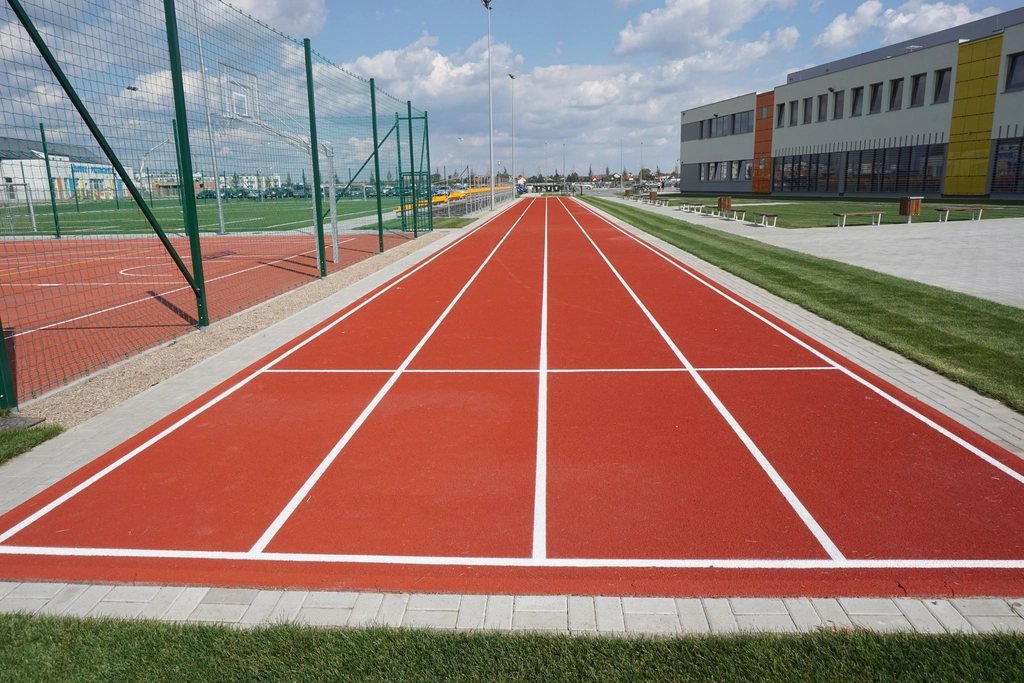
A standard outdoor athletics track measures exactly 400 metres in lane 1, measured 30 centimetres out from the inside kerb. Lane 2 is about 407.7 metres and each further lane adds roughly 7.7 metres, so run in lane 1 or correct for the lane you use. Turn off any track mode first, because it snaps the distance to the known lap length and would hide the very error you want to measure. Set the watch to record every second, choose the receiver mode you normally use, and wait a full minute after acquiring a fix before starting.
Run 10 laps in lane 1 at an even pace, pressing the lap button as you cross the same line each time. The true distance is 4000 metres. Note the watch total and every lap split. A well-behaved watch reads between 3950 and 4050 metres, an error under 1.25 percent, with individual laps between 390 and 410 metres. Then look at the map: a good receiver draws 10 overlapping ovals inside the track lines; a struggling one draws a blurred ring 5 to 10 metres wide with excursions onto the infield. Repeat the test in the other receiver mode on another day, and if possible on a morning and an evening, since satellite geometry changes through the day. The two totals tell you whether multi-band is worth its battery cost for your local conditions, and the per-lap spread tells you how much to trust the pace field during intervals.